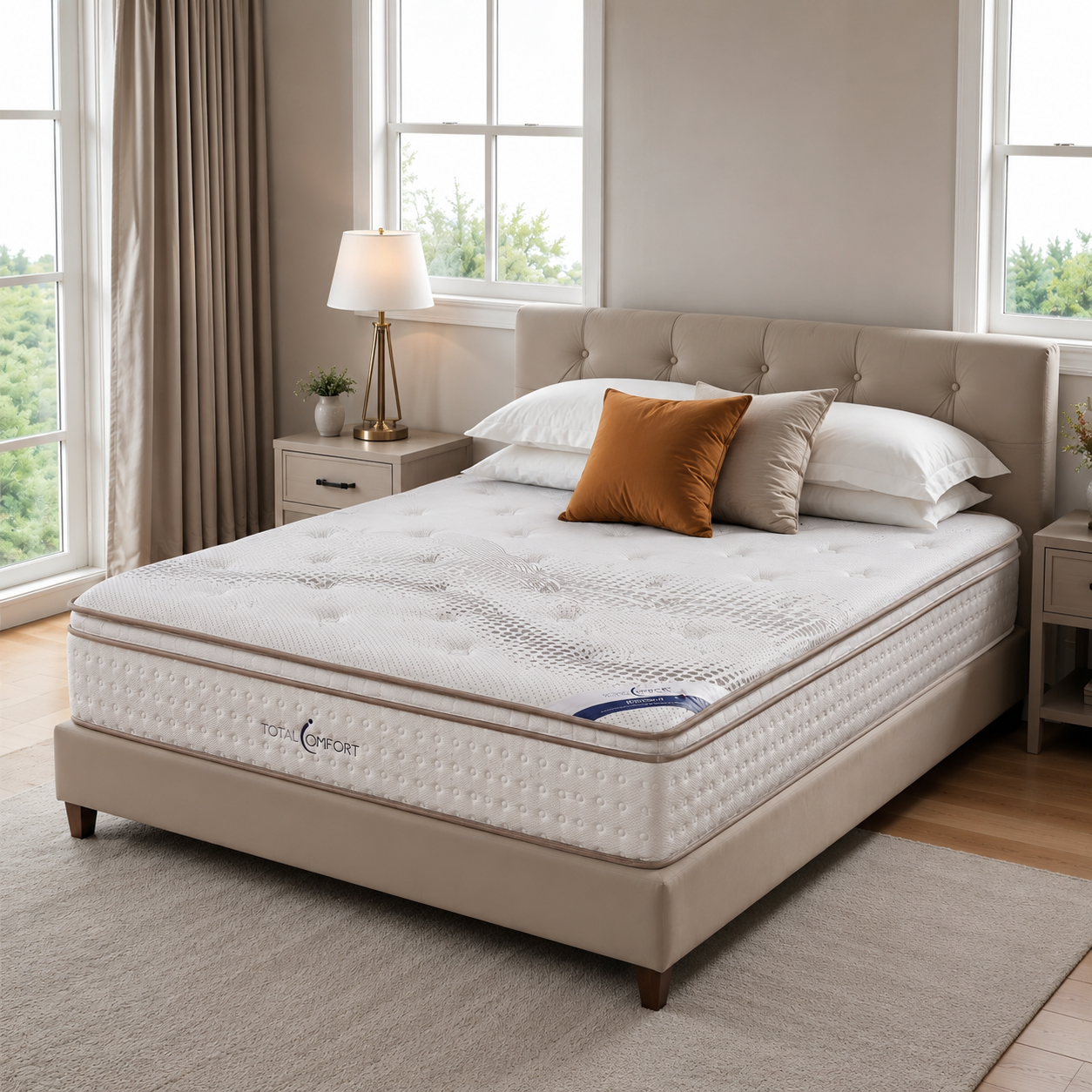
There is no single firmness that works for everyone, but most sleepers do best somewhere in the medium to medium-firm range. Where exactly you land depends on how you sleep, how much you weigh, and whether you're already dealing with back or joint discomfort.
The Short Answer on Mattress Firmness
There is no single firmness that works for everyone, but as a general rule, most sleepers do best on something in the medium to medium-firm range, firm enough to keep the spine supported, soft enough to let the shoulders and hips settle in. Where exactly you land on that scale depends on how you sleep, how much you weigh, and whether you are already dealing with back or joint discomfort. This guide walks through what firmness actually does to your spine, and which Total Comfort mattress fits where on that spectrum.
Getting this choice wrong is more common than people think. A mattress firm enough to eliminate pressure sores could still leave a lighter side sleeper aching at the shoulder by morning, while a softer mattress that feels plush in the first week can leave a back sleeper with an arched, unsupported lower back within a month. According to a review published in the Journal of Orthopaedics and Traumatology by Caggiari et al., mattress choice has a measurable effect on spinal alignment, sleep quality, and back pain outcomes, with medium-firm mattresses and those offering zoned support performing most consistently across studies.
Source: PubMed
Why Mattress Firmness Actually Matters for Your Spine
Firmness and support often get treated as the same thing, but they are not. A mattress can feel firm to the touch and still fail to keep your spine in a neutral position, which is really what matters for pain prevention.
A mattress that is too soft can cause the spine to sink and flatten while lying on the back, or create a hammock-like dip through the middle while lying on the side. Firmer support, by contrast, helps hold the spine neutral and takes pressure off the discs, which is one of the more common sources of lower back pain.
Source: Hoag Orthopedic Institute
This is backed up by clinical research as well. A randomised, double-blind trial published in The Lancet by Dr. Francisco Kovacs and colleagues followed 313 adults with chronic non-specific lower back pain over 90 days and found that those sleeping on medium-firm mattresses reported significantly better outcomes than those on firm mattresses. The takeaway is not that firmer is always better. It is that the right level of firmness depends on your body and how you sleep, which is exactly why Total Comfort builds across the full spectrum rather than pushing everyone toward one feel.
Source: The Lancet
Total Comfort's Firmness Spectrum, Explained
Every mattress feels different depending on the materials used underneath the surface. Here is how Total Comfort's range breaks down, from the softer end of the scale to the firmest.
| Mattress | Firmness | Type | Score |
|---|---|---|---|
| Somnus | Soft | Memory Foam Mattress | 89/100 |
| Aquilo | Soft | Cooling Gel Memory Foam Mattress | 89/100 |
| Fauna Natural Latex | Soft | Natural Latex Mattress | 90/100 |
| Boreas | Medium-Soft | Cool Gel Memory Foam Pocket Spring Mattress | 96/100 |
| Wild Latex | Medium | Natural Latex Pocket Spring Mattress | 97/100 |
| Zephyr | Medium | Memory Foam Euro Top Pocket Spring Mattress | 92/100 |
| Noctis Calm 5-Zone | Medium-Firm | Pocket Spring Mattress | 94/100 |
| Janus Premium Reversible | Medium-Firm | Pocket Spring Mattress | 88/100 |
| Celestia | Firm | Cool Gel Memory Foam Pocket Spring Mattress | 94/100 |
| Cor Lapius Rebonded-Foam | Extra-Firm | Ortho Rebonded Foam Mattress | 88/100 |
Scores are out of 100. Every mattress in the range includes a 30-night sleep trial and custom sizing on request.
For Side Sleepers and Pressure-Sensitive Bodies
A softer mattress is generally the right call for side sleepers, since this position needs enough give at the shoulder and hip to let the spine stay level rather than being pushed out of alignment. The Somnus Memory Foam Mattress is Total Comfort's medium-soft pick, built with pressure-relieving memory foam that cradles the shoulders and hips of side sleepers while a high-density foam base keeps the surface from collapsing entirely.
For sleepers who run warm, the Aquilo Cooling Gel Memory Foam Mattress offers the same medium-soft comfort feel with cooling gel infused into the foam, making it a practical option for hot UAE nights and for couples who want a plush surface without disturbing each other.
The Fauna Natural Latex Mattress with Bamboo Fabric rounds out this softer tier. Built with responsive natural latex over a supportive foam base, it suits sleepers who want the contouring feel of a medium soft mattress but with the breathability and bounce that natural latex offers over standard foam.
A Cooler, Springier Step Up
The Boreas Hybrid Cool Gel Memory Foam Mattress sits just above the softer tier. It pairs cooling gel memory foam with a pocket spring system underneath, giving side sleepers and couples a bit more responsiveness than pure foam while still keeping that medium-soft comfort feel on top.
A Balanced Middle Ground
The medium tier is built for sleepers who move between positions through the night and need a mattress that works reasonably well in all of them. The Wild Latex Hybrid Mattress combines a natural latex top layer with a pocket spring core, giving it a responsive, breathable feel that suits combination sleepers and couples who want consistent support without sinking too far.
The Zephyr Hybrid Memory Foam Mattress offers a similar medium feel through a memory foam Euro top layer over pocket springs, delivering plush contouring on the surface with the structural support of individually wrapped springs underneath.
Total Comfort's Most Recommended Range
A medium firm mattress is generally the safest starting point for most adults, and it is where the bulk of clinical research points as well. The Noctis Calm 5-Zone Pocket Spring Mattress uses a five-zone pocket spring system that adjusts to the back, hips, and shoulders individually, making it a solid orthopedic-leaning choice for back and stomach sleepers who still want some cushioning.
The Janus Premium Reversible Pocket Spring Mattress also sits in this range, with a consistent medium-firm feel on both sides thanks to its reversible construction. Its individually wrapped springs respond to the lumbar region independently from the shoulders, which is the kind of zoned, responsive support that tends to work well as a firm mattress for back pain without tipping into the extra-firm category.
For Back and Stomach Sleepers Who Need Extra Structure
The Celestia Cool Gel Memory Foam Mattress is Total Comfort's firm option, built with cooling gel memory foam over a pocket spring base. It suits back and stomach sleepers, along with hot sleepers who want a firmer feel without giving up temperature regulation, and its motion isolation makes it a reasonable pick for couples too.
The Firmest Mattress in the Range
For sleepers who need the most structured support available, the Cor Lapius Rebonded-Foam Ortho Mattress is the firmest mattress for back pain Total Comfort makes. Its spring-free, high-density rebonded foam core is designed for back and stomach sleepers who need therapeutic-level support, often on the recommendation of a physiotherapist or spine specialist.
How to Match Firmness to Your Sleep Position and Body Type
Sleep position is the biggest factor in choosing the right firmness.
- Side sleepers generally need a softer mattress, since the shoulder and hip need room to sink slightly to keep the spine level.
- Back sleepers do better with medium to medium-firm support, firm enough to hold the lumbar region up without letting it arch.
- Stomach sleepers usually need the firmest end of the scale, since a softer surface allows the midsection to sink and puts the spine in a hyperextended position.
Body weight matters too: A heavier sleeper will compress any mattress further than a lighter sleeper on the same surface, so someone who weighs more may need to size up in firmness regardless of position. This is one of the reasons Total Comfort recommends thinking about weight and position together rather than choosing firmness based on marketing labels alone.
Common Myths About Mattress Firmness
- Firmer always means healthier. As Jennifer Brandon, a physical therapist at Hoag Orthopedic Institute, points out, an extremely firm surface can actually cause discomfort for people with arthritic or achy joints, and those with sensitive skin should be mindful of pressure points on a very firm mattress. The truth is that firm is not automatically better, it is better for specific bodies and specific sleep positions, not a universal upgrade.
- If a mattress feels firm at first, it's the wrong one. What actually happens is that long hours in air-conditioned interiors followed by heat exposure outdoors can leave muscles tenser than usual, especially in the UAE, which sometimes makes a mattress feel firmer than it really is during the first few nights. The mattress hasn't changed, your body just needs a moment to unwind into it.
- You'll know within the first few nights whether a mattress is right for you. In reality, muscle memory and habitual sleep positions take time to reset, and most physiotherapists suggest giving a new mattress at least two to three weeks before judging it. This is exactly why Total Comfort backs every mattress with a 30-night sleep trial, so that adjustment period has room to play out properly.
People Also Ask
What firmness is best for back pain?
Research consistently points to medium-firm as the safest range for chronic lower back pain, rather than the firmest mattress available. A landmark study published in The Lancet found that medium-firm mattresses led to significantly better pain outcomes than firm mattresses over a 90-day period.
Is a softer mattress or a firmer mattress better for side sleepers?
A softer mattress is generally better for side sleepers, since this position needs enough give at the shoulder and hip to keep the spine level. A mattress that is too firm can create pressure points at these areas and throw the spine slightly out of alignment.
How do I know if my mattress is too soft or too firm?
If you wake up with your lower back aching or notice visible sinking in the middle of the mattress, it is likely too soft. If you wake up with numbness, tingling, or pressure soreness at the shoulder or hip, it is likely too firm for your sleep position.
Can couples with different firmness preferences share one mattress?
Yes, this is fairly common, and a medium or medium-firm mattress tends to be the best compromise for couples with different preferences, since it sits in the middle of the comfort range without being too soft or too firm for either sleeper.
Does body weight affect which firmness I should choose?
Yes. Heavier sleepers compress a mattress more than lighter sleepers do, which often means they need a firmer option to get the same level of support that a lighter person would get from a softer one.
The Right Firmness Changes Everything About How You Sleep
Firmness is not a matter of personal taste alone, it is one of the biggest factors in whether your spine actually gets the support it needs overnight. Total Comfort has spent over 25 years manufacturing mattresses across the full firmness spectrum right here in the UAE, built to match the way different bodies and different sleep positions actually work.
If you are still unsure where you fall on the scale, explore the full range below or speak to our in-house sleep specialists for a personalised recommendation.